Purpose: Calculate the height of objects on the moon by studying the length of their shadows.
References: Activities in Astronomy, p. 105-108
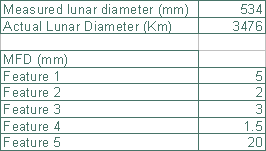
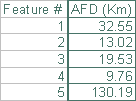
Procedure: From the Activities in Astronomy lab manual, we obtained a photo showing a number of features, such as craters and mountains, on the lunar surface. We then proceeded to measure the radius of several features in the image. Now, by comparing the Image feature diameter (IFD) to the ratio of the image lunar diameter (ILD) to the actual lunar diameter (ALD), we can estimate the actual feature diameter.
We then
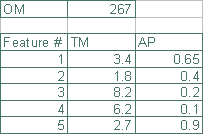
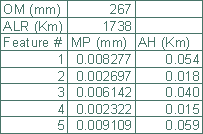
proceeded to estimate the height of a feature (MP) by comparing the length of
its shadow in the image (AP) to the ratio formed by the distance between the
terminator and the feature (TM) and the radius of the moon (
Data:
Size of Lunar Features:
Height of a Lunar Mountain or Crater Wall:
Calculations:
Size of Lunar Features:

Ex: 
Height of a Lunar Mountain or Crater Wall:
To calculate the height of a lunar feature, we must first calculate the scale height of the feature.

Ex: 
We can then calculate the height.

Ex: 
Results:
Size of Lunar Features:
Height of a Lunar Mountain or Crater Wall:
Conclusion:
Using the ratios and images provided in the
Activities in Astronomy Manual, we were able to practice calculating the
diameter and height of several lunar features.
We could have improved the accuracy of these calculations by using a
diagram with a larger scale. This would
have allowed for more precise measurements of distances on the image.